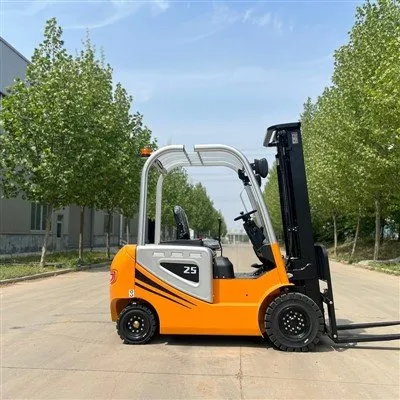
Forklifts are essential equipment in various industries, including warehousing, manufacturing, and logistics. They are designed to lift and move heavy loads efficiently and safely. One crucial factor that affects the performance and safety of a forklift is its ability to operate on slopes. In this blog post, I’ll share insights on the maximum slope a forklift can handle, and as a forklift supplier, I’ll guide you on how to make informed decisions when it comes to operating forklifts on inclined surfaces. Forklift
Understanding Forklift Slope Capacity
The maximum slope a forklift can handle is not a one – size – fits – all figure. It depends on several factors such as the design of the forklift, its weight distribution, the type of tires, and the load it is carrying.
Forklift Design
Different forklift designs have different capabilities on slopes. For instance, counterbalance forklifts, which are the most common type, rely on a heavy counterweight at the rear to balance the load at the front. These forklifts are generally stable on relatively gentle slopes. Reach trucks, on the other hand, are designed for narrow aisle operations and may have a lower maximum slope capacity due to their more slender design and higher center of gravity when the mast is extended.
Weight Distribution
Proper weight distribution is critical for a forklift to operate safely on slopes. When a forklift is on an incline, the weight shifts towards the lower end. If the load is not centered properly, it can cause the forklift to become unstable. A forklift with a well – distributed weight can handle steeper slopes compared to one with improper weight distribution. For example, if a forklift is carrying a load that is too far forward or to one side, it will be more prone to tipping over on a slope.
Tire Type
The type of tires on a forklift also plays a significant role in its slope – handling ability. Solid rubber tires provide good traction and stability on flat surfaces, but they may not be the best choice for steep slopes. Pneumatic tires, which are filled with air, offer better shock absorption and traction on uneven and sloped terrain. They conform to the surface better, providing more grip and reducing the risk of skidding.
Load Considerations
The weight and size of the load being carried by the forklift have a direct impact on its maximum slope capacity. A heavier load makes the forklift more difficult to control on a slope. Additionally, the shape of the load can affect the forklift’s stability. A tall and narrow load has a higher center of gravity, which makes the forklift more likely to tip over on an incline compared to a low and wide load.
Determining the Maximum Slope for Different Forklifts
Manufacturers typically provide guidelines on the maximum slope a forklift can handle. These guidelines are based on extensive testing and engineering calculations.
Indoor Forklifts
Indoor forklifts, such as electric pallet jacks and order pickers, are usually designed for use on flat surfaces. They generally have a maximum slope capacity of around 3 – 5%. This is because they are often used in warehouses with smooth floors and limited space for maneuvering. Operating them on steeper slopes can increase the risk of the load shifting or the forklift losing control.
Outdoor Forklifts
Outdoor forklifts, like rough – terrain forklifts, are built to handle more challenging conditions. They can typically handle slopes of up to 10 – 15%. These forklifts are equipped with features such as larger tires, powerful engines, and better suspension systems to improve their performance on uneven and sloped ground.
However, it’s important to note that these are general estimates, and the actual maximum slope a forklift can handle may vary depending on the specific model and its configuration.
Safety Precautions When Operating Forklifts on Slopes
Operating a forklift on a slope requires extra caution. Here are some safety precautions that operators should follow:
Pre – Operation Checks
Before taking a forklift onto a slope, operators should perform a thorough pre – operation check. This includes checking the brakes, steering, tires, and load – securing devices. Any signs of damage or malfunction should be addressed immediately.
Load Securement
The load should be properly secured to prevent it from shifting during operation on the slope. Use straps, chains, or other appropriate securing devices to keep the load in place. Heavier loads should be centered on the forks and kept as low as possible to lower the center of gravity.
Ascending and Descending
When ascending a slope, the load should face uphill to prevent it from sliding off the forks. The forklift should be driven in a straight line at a slow and steady speed. When descending, the load should also face uphill, and the operator should use the brakes carefully to control the speed.
Training
Operators should receive comprehensive training on how to operate forklifts on slopes. This training should cover safety procedures, load handling, and the limitations of the forklift. Regular refresher courses should also be provided to ensure that operators stay up – to – date with the latest safety practices.
How We Can Help as a Forklift Supplier
As a forklift supplier, we understand the importance of providing our customers with the right equipment and information to operate forklifts safely on slopes.
Customized Recommendations
We offer customized recommendations based on your specific needs. Our team of experts will assess your work environment, including the slopes on your site, the type of loads you handle, and your operating requirements. Based on this assessment, we will recommend the most suitable forklift models with the appropriate slope – handling capabilities.
Training and Support
We provide comprehensive training programs for forklift operators. Our training covers all aspects of forklift operation, including how to handle slopes safely. We also offer ongoing support to our customers, including maintenance services and technical advice.
Quality Equipment
We supply high – quality forklifts from leading manufacturers. Our forklifts are designed to meet the highest safety and performance standards. We also ensure that our forklifts are regularly maintained to keep them in optimal condition, which is especially important when operating on slopes.
Conclusion
The maximum slope a forklift can handle is a complex issue that depends on multiple factors. As a forklift supplier, we are committed to helping our customers make informed decisions about forklift selection and operation on slopes. Whether you are operating in a warehouse with gentle slopes or a construction site with more challenging terrain, we have the expertise and the equipment to meet your needs.
Wheel Loader If you are looking for a reliable forklift solution for your business, especially one that can handle slopes safely and efficiently, we’d love to start a conversation with you. Contact us to discuss your requirements, and our team will be happy to provide you with detailed information and quotations.
References
- "Forklift Safety Manual", Occupational Safety and Health Administration (OSHA)
- "Industrial Forklifts: Design and Operation", Industrial Truck Association (ITA)
- Technical specifications provided by leading forklift manufacturers.
Jining Sunsail Machinery Co., Ltd.
With abundant experience, we are one of the most professional forklift manufacturers and suppliers in China. We warmly welcome you to buy high-grade forklift made in China here from our factory. For price consultation, contact us.
Address: Room 410, Digital Industry Building, Rencheng District, Jining City, Shandong Province,China
E-mail: Sunsail_machinery@163.com
WebSite: https://www.sunsailmachine.com/
